http://www.dsti.net/News/53456.htm
韓國KF-16戰鬥機將裝備JDAM制導炸彈
[據美國《防務新聞》2009年5月6日報導] 今年晚些時候,韓國空軍的升級型KF-16戰鬥機將掛載精確制導的聯合直接攻擊彈藥(JDAM)。
該裝備升級是2010-2014年武器採購與管理計畫的一部分,該計畫很快就會提交到李明博總統那裏以待批復。
一旦出現緊急情況,裝備JDAM炸彈的KF-16飛行聯隊將能夠對朝鮮境內山洞和山體隧道內的炮兵部隊進行外科手術式的打擊。
KF-16是韓國本土設計的戰鬥機,以洛克希德•馬丁公司的F-16C/D為基礎。目前韓國擁有新老兩支飛行聯隊:一支裝備著20世紀80年代採購的34架Block 32 F-16戰鬥機,另一支則擁有135架較新的本土生產的Block 52 F-16戰鬥機。
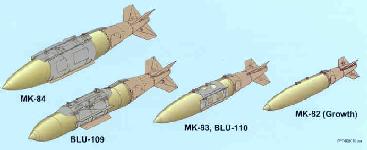
GBU-31 JDAM是一種制導尾翼元件,可將現有的非制導自由降落的炸彈改造成精確制導炸彈。可對付靜止的及重新定位的目標。據韓國空軍官員透露,該炸彈射程24千米,目標精度13米,能侵徹2.4米厚的混凝土。 (北方科技資訊研究所 李寶鋒)
http://www.defensenews.com/story.php?i=4076484&c=ASI&s=AIR
S. Korea to Arm KF-16s with JDAMs
By JUNG SUNG-KI
Published: 6 May 2009 13:47
SEOUL - The South Korean Air Force will fly upgraded KF-16 fighters carrying precision-guided Joint Direct Attack Munitions (JDAM) by the end of the year, a military source here said May 5.
The armament upgrade is part of the 2010-2014 arms acquisition and management plan being submitted soon to President Lee Myung-bak for approval, the source noted.
The JDAM-equipped KF-16 fleet would be able to conduct surgical strikes against thousands of North Korean artillery pieces hidden in mountain caves and tunnels near the border with South Korea in case of an emergency, said the source privy to the Air Force's arms improvement plans.
The KF-16 is the local designation for the F-16 C/D model of the Lockheed Martin-built Fighting Falcon. South Korea now operates an older fleet of 34 Block 32 F-16s purchased in the 1980s, as well as a newer fleet of 135 F-16s manufactured locally to the Block 52 standard from the mid-1990s to mid-2000s under a $5.5 billion licensing agreement.
The upgrades will initially be applicable to a fleet of about 20 newer Block 52 models delivered from 2003 to 2004, he said.
"The Air Force has been working together with the U.S. Air Force for the past years on improving the KF-16's computer systems, databases and cabling so that the aircraft will be able to carry a batch of advanced guided weapons, including JDAMs, AIM-9X tactical air-to-air missiles and GBU-24 laser-guided bombs," he said.
To that end, the Air Force has been studying ways to downsize the 2,000-pound JDAM to 1,000 or 500 pounds so the KF-16s can operate the GPS-guided weapon more effectively, he said.
"The upgrade works have almost been completed, as the KF-16 will be operational with JDAMs by year's end after ground and air-to-ground testing between July and August," the source said.
Once deployed, the KF-16 fleet with JDAMs backed by long-range F-15K fighters will play a key role in neutralizing North Korea's long-range artillery systems deployed near the heavily fortified inter-Korean border, he said.
The JDAM GBU-31 is a guidance tail kit that converts existing unguided free-fall bombs into accurate, adverse weather munitions. It enables employment of accurate air-to-surface weapons against high priority fixed and re-locatable targets. Guidance is facilitated through a tail control system and a GPS-aided internal navigation system. Its per-unit price is about $43,000.
The bomb has a range of 24 kilometers and can strike within 13 meters of its target, according to Air Force officials here. It can penetrate up to 2.4 meters of concrete, they said.
Radar Upgrade
Another key upgrade for the KF-16 will be a replacement for its existing APG-68(v)5/(v)7 radar systems, the source said.
The Defense Acquisition Program Administration confirmed the move. The agency said in a news release May 4 that it has been conducting a preliminary research on the KF-16 radar replacement but has not made a decision.
The Air Force is considering the EL/M-2032, developed by Israel's Elta Systems, which will also equip the service's FA-50 trainer-turned-lightweight fighters to be developed by 2012.
The mechanically scanned array radar is credited with a look-up tracking range of up to 100 kilometers and is thought to have better simultaneous target tracking capability than that of the current KF-16 radars.
"The Air Force was initially considering more advanced U.S. active electronically scanned array [AESA] radars, such as Northrop's Scalable Agile Beam Radar and Raytheon's active next generation radar, but has modified the idea due to the U.S. law forbidding the export and technology transfer of state-of-the-art weapon systems," the source said.
The rationale behind the move is the service's long-term plan to develop an indigenous AESA radar based on modern radar technologies from Israel, which is more amenable to technology transfer than is the U.S., he explained.
South Korea was forced to drop its earlier plan to equip the FA-50, a light attack variant of the T-50 built by Korea Aerospace Industries and Lockheed Martin, with the Vixen-500e AESA radar developed by U.K. firm Selex Sensors and Airborne Systems because of U.S. opposition.
Lockheed Martin opposed it, saying aircraft source code cannot be transferred to other nations and T-50 variants cannot be integrated with non-U.S. technology.
Instead, the U.S. firm pushed South Korea to select its AN/APG-67(v)4 radar, but the U.S. government this time rejected the move, citing the T-50 family's development and marketing agreements.
One of those agreements states that T-50 series aircraft may not be fitted with radars more advanced than the ones carried in KF-16s.
Lockheed later agreed on the installation of the Israeli radar because the system is to be integrated by U.S. firm ITT Defense, sources said.


 本城市首頁
本城市首頁 看回應文章
看回應文章



 等級:8
等級:8